

By Bailey Arman, associate director of communications
“I had to fight for doctors to take my symptoms seriously for years, and finally, I have an answer on how I can treat these symptoms, but learning how to navigate every food or product that comes near my mouth is overwhelming.”—An adult newly diagnosed with celiac disease.
No one should fear that food will hurt them. Unfortunately, that’s the reality for many people with celiac disease, a chronic autoimmune disease. For them, ingesting small amounts of gluten, found in wheat, barley or rye, can cause debilitating symptoms and internal damage. Because there’s no pharmaceutical treatment, the only way to manage the condition is with a strict, lifelong gluten-free diet. The burden of avoiding gluten rests entirely on the patient themselves, or their caregivers.
But with a few small changes—including some already proposed to the government—we can lighten that load.
Food Labeling in the United States
In the United States, food manufacturers are required to say if their products contain any of the top nine allergens: milk, eggs, fish, shellfish, tree nuts, peanuts, wheat, soybeans, and sesame.
Note that wheat is listed, but barley and rye are not. Those with celiac disease cannot rely on wheat allergen labeling alone to safely select food. Instead, they have to decipher the entire ingredients list for the terms “barley,” “rye”, or a host of other vague phrases that could indicate either of those two ingredients (see image).
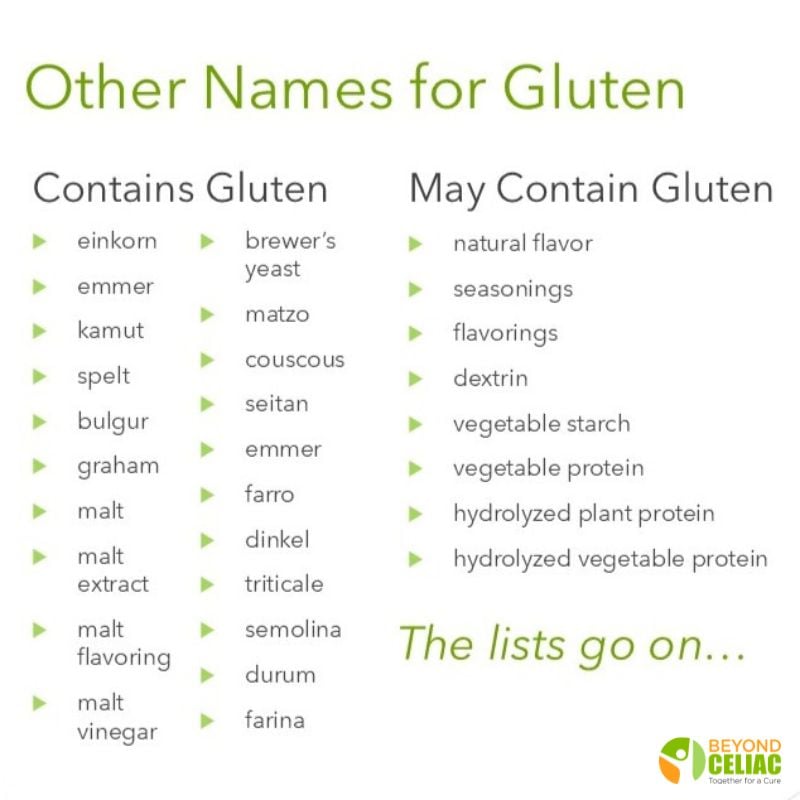
As one patient explained, “I will be down and unable to function for a full day. It takes 4-7 days for my symptoms to resolve, but […] even after you feel ok again, your body takes longer to heal damage. I am extremely careful, but I still make mistakes with ‘natural colors’ or ‘natural flavors’ sometimes. I have stopped buying any of those because I don’t know what is in them. Please, please help us identify what is in our food.”
Seeing a product labeled “gluten-free” can be reassuring, but in the United States, this label is entirely voluntary. Manufacturers are not required to disclose whether or not something could be safe for the millions of people with celiac disease—they are only required to share if it has wheat.
It doesn’t have to be this way. In many countries, including all those in the European Union, manufacturers must disclose whether a product contains gluten.
A safer, more transparent food system in the United States is possible—and it just may be on the way.
In early 2026, the United States Food and Drug Administration (FDA) issued a Request for Information (RFI) on the topic. Essentially, they wanted to hear opinions from patients, food manufacturers, researchers, anyone with an interest in the issue, on whether or not it’s worthwhile to require the labeling of all gluten-containing ingredients.
The Beyond Celiac team rolled up our sleeves and got to work.
Collecting Community Perspectives
In partnership with Celiac Journey, who originally petitioned the US government to address this critical issue, we developed a survey to consolidate patient perspectives on whether or not barley, rye, and oats should be labeled. We also encouraged community members to personally respond to the RFI expressing their opinions, should they want to.
Our survey was distributed via social media and email, and eligible respondents were US residents aged 18 years or older. From March 5–17, 2026, we collected 1,959 complete responses. Of those respondents, about 77% have celiac disease or avoid gluten for medical reasons, and about 32% care for a child who has celiac disease or avoids gluten for a medical reason.
Of the nearly 2,000 people who completed the survey, 91% of respondents have been following the gluten-free diet for two years or more, so most of these people are very familiar with the medical diet, and have been shopping for gluten-free products for years.
The Consequences of Accidental Gluten Exposure
Regardless of symptoms and symptom intensity, which varied widely among respondents, the survey-takers consistently expressed fear and concern about their own or their child’s physical, mental, and emotional safety due to the very basic need for safe foods.
Despite the fact that this population has a lot of experience reading labels, accidental exposure to gluten happens frequently. In fact, survey data indicate that over a third of children who require a gluten-free diet still accidentally consume gluten at least monthly. Additionally, when children get glutened, nearly half experience symptoms for four or more days.
Of all respondents:
- 91.1% report gastrointestinal symptoms
- 67.9% report physical signs and symptoms
- 67.6% report neurological symptoms
Recovery from gluten exposure is prolonged:
- 45.9% of adults require 2–3 days to return to normal routines
- 53.1% report symptoms lasting four days or longer
- 47.1% of children experience symptoms lasting at least four days
One parent recounted what typically happens when their child is exposed to gluten, sharing that “when he ingests gluten, he experiences projectile vomiting that can last for a couple of hours until his stomach is emptied. After vomiting, he is completely worn out and lethargic, often falling asleep with his head resting on the toilet seat. His exhaustion is profound, and he sleeps for hours afterward. We try to reintroduce food very slowly once he feels able to eat.”
Consumers Want More Straightforward Labels
So how do these respondents determine whether or not a product is safely gluten-free?
- 85–91% review ingredient lists when products are not clearly labeled
- 80–87% look for allergen (“contains”) statements
- 66–84% review “may contain” or shared equipment statements
- Up to 61% consult external databases
- Up to 36% contact manufacturers directly
This data suggests that consumers rely on multiple imperfect strategies to assess product safety. One parent summarizes his frustration with ingredient transparency: “My daughter shouldn’t need a degree in food science to evaluate if a product is gluten-free. It’s maddening. We need more regulation and labeling so our celiac families can eat safely. This disease delivers such a blow to mental health and the ability to be social. We have so far to go; this labeling step is just one of many needed.”
Respondents are also wary of ambiguous labels such as natural flavors, with 92.2% avoiding products over concerns about gluten in ingredient list items such as natural flavorings or seasonings. One respondent shared, “I have gotten very sick on multiple occasions from products that have ‘natural flavors,’ thinking they were okay because they did not contain wheat, but it turns out that they had gluten-containing natural flavor ingredients.”
Explicitly requiring barley and rye to be labeled could prevent these sorts of situations entirely—a measure that is almost unanimously supported by our community.
99% Support Labeling Barley and Rye
Nearly every respondent supported labeling barley and rye.
- 99.2% say labeling barley and rye is meaningful to them
- 90.7% say it would make them feel safer and more comfortable purchasing products
- 87.9% say it would increase confidence in purchasing decisions
- 59.4% say it would reduce time spent analyzing labels
Most Want Oats Labeled, Despite Being Technically Gluten-Free
Oats are in a gray space for those on a medically necessary gluten-free diet. Although naturally gluten-free, oats often come into contact with gluten-containing grains during processing. One Canadian study found that 88% of oat samples were contaminated with gluten, most often barley. Because of this, a few countries, including Australia, do not allow any products with oats to be labeled gluten-free. In the United States, though, products with oats are allowed to be labeled gluten-free, and some oat products are even certified gluten-free; in other words, the product has been tested and verified to contain 20ppm or less of gluten.
Still, the patient population remains concerned. Although not as universal as barley and rye, support for labeling oats is also strong:
- 89.6% say labeling oats is meaningful
- 84.2% report it would make them feel safer
- 82.6% report increased confidence when purchasing products
This supports the FDA’s consideration of oats as a distinct regulatory category, recognizing both consumer concerns and existing gluten-free standards.
Our Recommendation to the FDA
It’s not an exaggeration to say that clear, consistent labeling directly affects short-term and long-term health and allows people with medical needs to make informed, critical decisions about their food.
Scientific studies and patient experience indicate the current state of food labeling for barley, rye, and oats creates significant and unnecessary risks for individuals and families managing celiac disease and medically necessary gluten-free diets. Accidental gluten exposure remains common, with severe and lasting effects on health, daily functioning, and mental well-being, especially among children. Despite their diligence, consumers are forced to navigate a confusing and often opaque labeling environment, leading to ongoing anxiety and a loss of trust in the food supply.
Based on this information, we, on behalf of the community, urged the FDA to implement:
- Mandatory labeling of barley and rye in allergen statements or equivalent standardized disclosures.
- Clear, consistent treatment and labeling of oats, aligned with gluten‑free labeling standards and cross‑contact risks. When used, the packaging should indicate whether the oats are certified gluten-free or not.
- Recognition that existing labeling frameworks are insufficient even for experienced consumers. Voluntary labeling efforts, while well-intentioned, remain inconsistent in usage and do not guarantee that allergens are fully disclosed.
These steps would meaningfully reduce accidental exposure and improve consumer confidence without requiring consumers to act as food‑label experts.
On April 22, 2026, Beyond Celiac filed our recommendations in a formal comment on the RFI.
As of publishing this article in June of 2026, we are proud to say that your voices have been heard, and the government is responding.
Government Action and How You Can Help
On May 28, 2026, as a final celebration of Celiac Awareness Month, US Representatives Emanuel Cleaver, II (D-MO) and Betty McCollum (D-MN) introduced H.R. 9048, or the Celiac Safety Act of 2026, to the House of Representatives. This would require food manufacturers to disclose barley and rye alongside wheat in the allergen statement of a label.
Want this bill to become law? If you’re a US citizen, reach out to your representatives and ask them to co-sponsor the bill and support it. You can find your representatives by visiting house.gov and entering your zip code in the upper right corner.
A safer, more transparent food system is possible. Together, we can make it a reality.
August 2026 Update
In the time since publication, two additional bills related to gluten labeling have been introduced to Congress. The FASTER Act of 2026, bill H.R. 9988, would replace wheat as an allergen with the term “gluten-containing grain,” defined as wheat, barley, rye, oats, and any crossbred hybrid of such grains, such as triticale. The Food Labeling Modernization Act of 2026, bill H.R. 8385, would amend the Food Allergen Labeling and Consumer Protection Act of 2004 to include gluten-containing grains alongside allergens (but does not classify gluten-containing grains as an allergen).