Food Safety For Living With Celiac Disease
Jump to:
Most people on the gluten-free diet are often surprised by how complicated it can be—at least initially. We promise it gets easier! At Beyond Celiac, we’re here to help you understand how to identify safe foods, read labels, and know which certifications you can trust so that you can live an empowered life.
Gluten Free Food Labeling Laws
The U.S. Food and Drug Administration (FDA) finalized a standard definition of “gluten-free” in August 2013. As of August 5, 2014, all manufacturers of FDA-regulated packaged food making a gluten-free claim must comply with the guidelines outlined by the FDA.
When you see the words “gluten-free,” “free of gluten,” “no gluten,” and “without gluten,” on an FDA-regulated food, it means that the product either:
- Inherently does not contain gluten (i.e. a bag of raw carrots or bottle of water)
OR meets the following criteria:
- Does not contain an ingredient that is a whole, gluten-containing grain (i.e. wheat, barley, rye or crossbred hybrids of these grains)
- Does not contain an ingredient that is derived from a gluten-containing grain and has not been processed to remove gluten (i.e. wheat flour)
- May contain an ingredient that is derived from a gluten-containing grain that has been processed to remove gluten (i.e. wheat starch) as long as the food product contains less than 20 parts per million (ppm) of gluten
AND
Any unavoidable gluten in the food due to cross-contact (commonly referred to as cross-contamination by the gluten-free community) or migration of gluten from packaging materials is less than 20 parts per million (ppm) gluten

What does 20 Parts Per Million (PPM) mean?
It is a common misconception that foods labeled “gluten-free” can or do contain zero parts per million (ppm) of gluten. At this time, no validated tests are able to accurately detect gluten at zero. Less than 20 ppm is an amount that has been deemed safe by celiac disease experts for most people living with the genetic autoimmune disease.
Tricia Thompson, MS, RD of Gluten-Free Watchdog, LLC uses this example:

If you bought a bag containing one million blue marbles, but the bag actually contained 999,980 blue marbles and 20 red marbles, you could say that the bag of marbles was contaminated with 20 ppm red marbles.
Gluten Free Certification
Gluten-free certification is a process designed to protect consumers with celiac disease and other gluten-related disorders by confirming that a food, drink or supplement meets strict standards for gluten-free safety. It assures consumers that there is third-party oversight confirming the legitimacy of the manufacturer’s gluten-free processes and claims.
There are several certifying organizations that offer gluten-free certification, and each has its own criteria to ensure safety for consumers.In the grocery store, certification seals make it easier to identify safe and trusted products.
Beyond Celiac Endorses BRCGS’ Global Standard Gluten-Free (GSGF)
Beyond Celiac endorses BRCGS’ Global Standard Gluten-Free, a management system-based approach to controlling gluten for manufacturers. The program was created in 2011 by the Allergen Control Group (now owned by BRCGS) and the Canadian Celiac Association. In 2014, Beyond Celiac brought this system to the U.S. This alliance makes the GSGF the first North American program endorsed by leading celiac disease organizations in both the U.S. and Canada.
The GSGF is a management system and facility-based certification. This means that the program does not rely solely on product testing to ensure safety, but examines the entire practices and production process of the facility. This ensures that gluten is controlled in every aspect of the facility’s operation, from ingredient sourcing to employee training, cleaning practices, cross-contact controls, operational management and, an effective end-to-end testing plan.
The GSGF approves only those facilities that continually meet strict manufacturing practices for gluten-free production. Certification audits are conducted annually by trained and approved, independent International Standard for Organization (ISO) and third-party accredited certification bodies. Products manufactured in facilities that have earned GSGF certification may bear a clear and easy-to-recognize trademark from Beyond Celiac on their packaging.
By having qualified third-party professionals involved in each major step of the certification process, BRCGS supports a system of checks and balances eliminating any potential for conflict of interest between the manufacturer’s relationship with the program, its certifying bodies and/or Beyond Celiac.
Reading Food Labels
Food labels are your first defense against accidental gluten exposure. While label reading can seem overwhelming at first, you’ll become confident over time. Download the Beyond Celiac Step by Step Guide to Reading Gluten-Free Labels to help you navigate the supermarket shelves.
Thank you to Cabot Creamery, Crunchmaster and Glutino for making this resource possible.

Gluten-Free Labels Safety Rankings
The information below is not medical advice nor is it legally binding. If you have safety concerns, please contact the manufacturer directly or your healthcare team.

Certified gluten-free
Certified gluten-free products are tested and proven to contain less than 20 ppm of gluten.
Labeled gluten-free
In the US, any product labeled gluten-free is legally required to contain less than 20 ppm of gluten. However, manufacturers are not required to test and verify their products have less than 20 ppm gluten.
Labeled gluten-free and has a “made in a facility that processes wheat
The “made in a facility” label is voluntary and unregulated—it has no definition. If the product is labeled gluten-free, it must contain less than 20 ppm. Products made in a facility that processes wheat can still be safely gluten-free.
Unlabeled, but no gluten ingredients
A product that is not labeled gluten-free and does not contain any gluten ingredients can still be totally safe for someone with CD. For example, a bag of carrots or apples. However, the longer the ingredients list, the more careful you may want to be.
Made in a facility / may contain
The packaging doesn’t list any gluten-containing ingredients, but it says “made in a facility that also processes wheat” or “may contain wheat.” It could still be totally gluten-free, but it’s not the safest option.

Contains gluten
Do not consume any products that list gluten-containing ingredients in the label, such as wheat, barley, rye, etc.
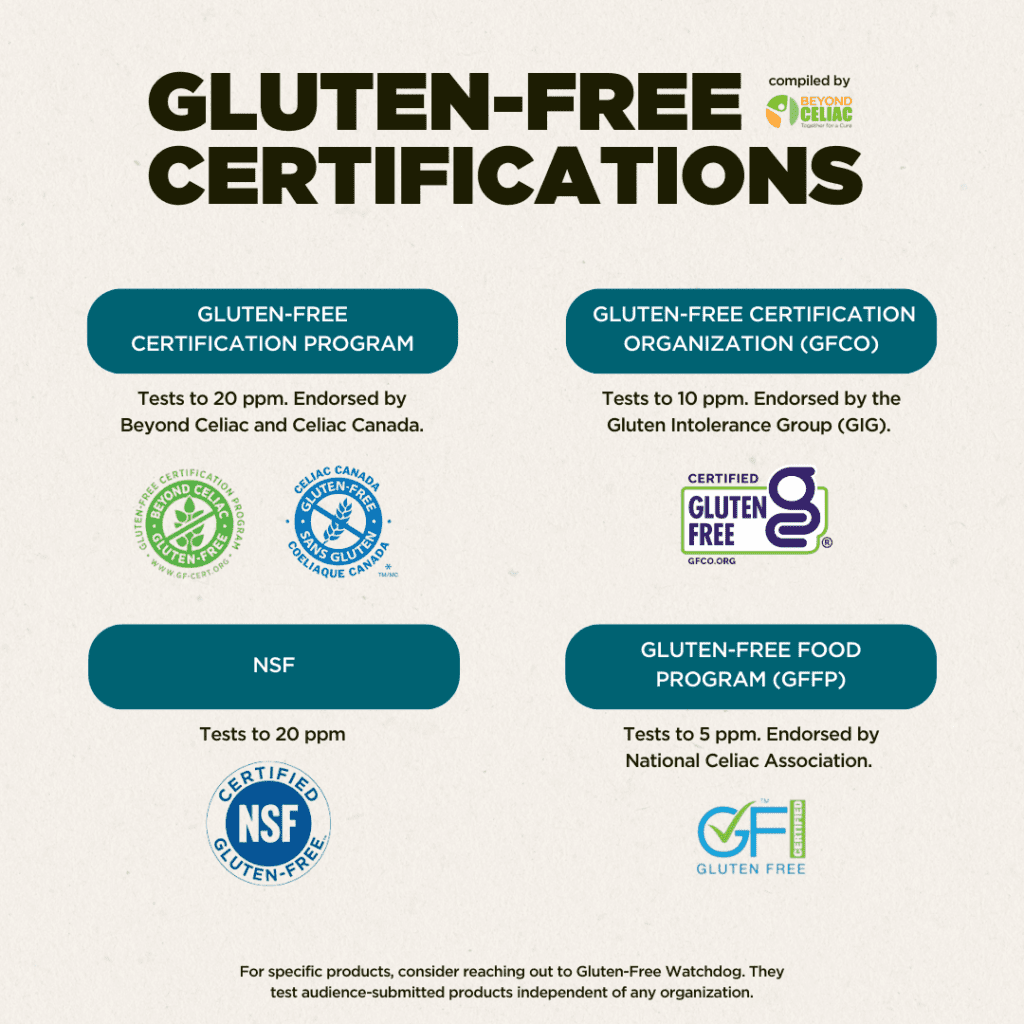
Gluten Free Certifications
Gluten Free Certification Program
Tests to 20 ppm. Endorsed by Beyond Celiac and Celiac Canada.
Gluten Free Certification Organization (GFCO)
Test to 10 ppm. Endorsed by the Gluten Intolerance Group (GIG).
NSF
Tests to 20 ppm.
Gluten Free Food Program (GFFP)
Tests to 5 ppm. Endorsed by the National Celiac Association.
Need more help navigating the Gluten Free Diet?
Download this free, comprehensive resource, Introducción: Guía sobre la enfermedad celíaca y la dieta sin gluten, from Beyond Celiac.