
Most people with celiac disease are used to searching for resources about symptoms, how to live with the condition, and what to expect long-term. Since there aren’t many celiac disease specialists, it’s not uncommon for patients to know more about the nuances of the disease than their providers.
At the same time, in the age of information, it can be difficult to sort out what is reputable advice and what is better left to the internet trolls. Some of our most popular and scientifically-backed resources include:
- Celiac Disease Symptoms and Celiac Disease Symptoms Checklist
- The Beyond Celiac Getting Started Guide
- Noticias sobre investigación
- and The Beyond Celiac Resource Library
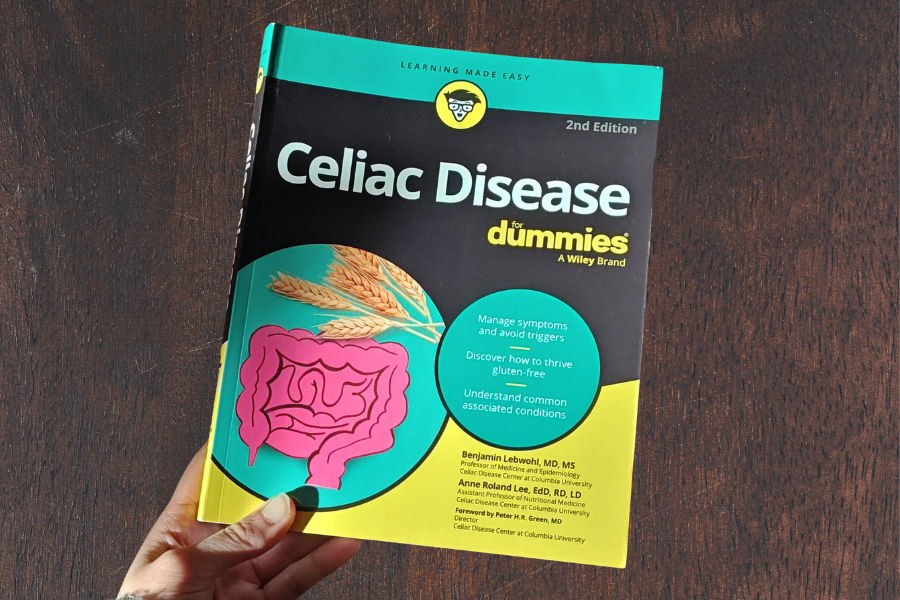
But there is always more! More symptoms to understand, more tools to try, more recipes to learn. And in a community that is hungry for more information (hold the gluten), we are always looking for what can help more people live healthy lives with celiac disease. This is why we were so pleased to receive a copy of the recently released Celiac Disease for Dummies, Second Edition, by Benjamin Lebwohl, MD, MS, and Ann Roland Lee, EdD, RD, LD.
Our Chief Science Officer, Debra Silberg, MD, PhD, FACG, shares her thoughts as an accomplished gastroenterologist, researcher, and author in the field of celiac disease research. She includes some of her favorite chapters for understanding the full extent of the gluten-free diet, and why the second edition of Celiac Disease for Dummies is such a comprehensive resource.
In summary: head to your local library or add it to your cart. This one is worth having in your gluten-free toolkit.
Celiac Disease for Dummies (2nd Edition) Review
Reviewed by Beyond Celiac CSO Dr. Debra Silberg
Celiac Disease for Dummies, 2nd Edition 2026, authored by Benjamin Lebwohl, MD, MS, and Ann Roland Lee, EdD, RD, LD, is a comprehensive resource for those with celiac disease, whether you are recently diagnosed or have been living with celiac disease for a while. The book is also a valuable source of information for friends and family members.
It is written in an easy-to-read manner, with some lightheartedness to engage the reader while maintaining the seriousness of the condition. Examples of the content include “Chapter 3: Diagnosing Celiac Disease”, a step-by-step guide as to what to expect in evaluating whether you have celiac disease, from symptoms, physical exam, tests, and endoscopy. It is an important chapter because there are many people who are not certain if they have a diagnosis of celiac disease, and this chapter explains the steps to diagnosis. There is a section on diagnosing celiac disease if you are already on a gluten-free diet before testing, which makes the tests difficult to interpret. ‘Chapter 5: Celiac Disease and You’, explains the scientific basis of celiac disease in terms that are easy to understand. Chapters 5 and 10 are extremely helpful in understanding the gluten-free diet, while Chapter 11 discusses nutritional considerations while on a gluten-free diet.
There is, of course, a lot more information in this book, including Frequently Asked Questions (Chapter 16), Tips for Living with Celiac Disease (Chapter 17), and myths about celiac disease (Chapter 18).
The book has a very comprehensive Table of Contents so that if there is a topic of interest, it is easy to find and explore. There are many tips and useful information to navigate celiac disease. This is a must-read for those with celiac disease, or for friends and family members who want to learn more.
Disclaimer: I received the book for free, but I do not have any financial connection with the book and was not asked to write a review.